

Losing weight is often portrayed as a simple matter of "willpower." Eat less, move more, and the pounds will melt away—right? This oversimplified narrative has left millions of people feeling like failures when their diets inevitably stall or reverse.
The uncomfortable truth? The science of weight loss reveals a far more complex picture than the fitness industry wants you to believe. From the way your body burns energy at rest to the complex hormonal signals that dictate hunger, your biology is actively working against your weight loss goals—and it is doing exactly what it evolved to do.
This guide breaks down the evidence-based strategies, metabolic principles, and psychological factors you need to know to lose weight sustainably and keep it off.
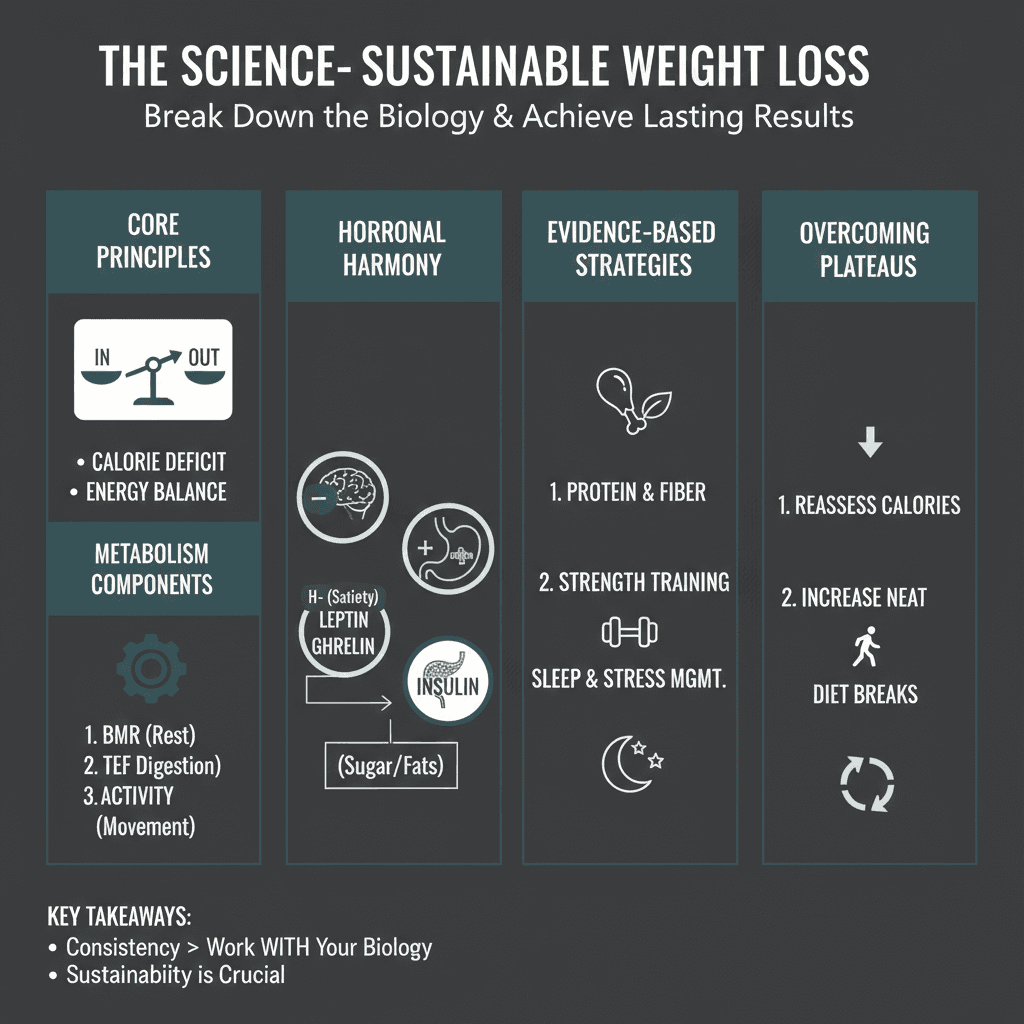
The Core Principle: Energy Balance and Calories
At its most fundamental level, weight loss is governed by the law of thermodynamics. To lose weight, you must achieve a calorie deficit—meaning you expend more energy than you consume.
Here's where the controversy begins.
The Calorie Deficit: Both True and Misleading
The "calories in, calories out" (CICO) model has dominated weight loss advice for decades. And while it's technically accurate, treating it as the complete picture has led countless dieters astray.
The controversial reality: Your body isn't a calculator. When you cut calories, your body doesn't just passively accept the deficit. It fights back. Your metabolism slows. Your hunger hormones surge. Your unconscious movements decrease. The calorie equation you calculated on day one becomes obsolete by week three.
This doesn't mean calories don't matter—they absolutely do. But obsessing over precise calorie counts while ignoring the quality of those calories and your body's hormonal response is why most diets fail within the first year.
The Three Components of Your Metabolism
Your metabolism isn't just one "speed" that is either "fast" or "slow." It is composed of three distinct ways your body burns energy.
1. Basal Metabolic Rate (BMR)
Your BMR is the energy required to keep your body functioning at rest—breathing, heart rate, cell production, brain function. It typically accounts for 60-75% of your total daily energy expenditure.
Read that again. The majority of the calories you burn have nothing to do with your workout.
The controversial implication: Spending hours on a treadmill while ignoring the factors that influence your BMR (sleep, stress, muscle mass, hormonal health) is like trying to bail out a sinking ship with a teaspoon while ignoring the hole in the hull.
2. Thermic Effect of Food (TEF)
The TEF is the energy used to digest, absorb, and process the nutrients in your food. Different macronutrients require different amounts of energy:
- Protein: 20-30% of calories burned in digestion
- Carbohydrates: 5-10%
- Fats: 0-3%
What this means: 200 calories of chicken breast has a fundamentally different metabolic impact than 200 calories of olive oil. The "a calorie is a calorie" crowd conveniently ignores this biological reality.
3. Physical Activity and NEAT
NEAT (Non-Exercise Activity Thermogenesis) is the energy spent on everything from walking to the car to fidgeting and maintaining posture. It varies enormously between individuals and can fluctuate by several hundred calories per day. Some research suggests that when people begin exercise programs, their NEAT unconsciously decreases to compensate—they move less throughout the rest of the day. This is one reason why adding exercise alone rarely produces the weight loss results people expect.
The Role of Hormones in Weight Management
Weight loss is not just a math problem—it is a hormonal one. Your body uses a complex signaling system to regulate appetite and fat storage, and ignoring this system is why willpower-based diets have a failure rate exceeding 90%.
Leptin: The Satiety Signal Your Brain Stops Hearing
Leptin is produced by fat cells and signals your brain to stop eating. In obesity, leptin resistance often occurs—the brain stops responding to leptin signals despite elevated levels. It's like shouting at someone wearing noise-canceling headphones.
Ghrelin: The Hunger Hormone That Sabotages Your Diet
Ghrelin is secreted by the stomach when it's empty. Here's the problem for dieters: ghrelin levels increase when you lose weight and remain elevated for at least a year after weight loss.
This isn't a character flaw. This is your body's survival mechanism working exactly as designed. Your biology doesn't know you're trying to fit into smaller jeans—it thinks you're facing a famine.
Insulin: The Storage Hormone
Insulin regulates blood sugar and fat storage. High insulin levels—often caused by diets high in refined sugars and processed carbohydrates—can make it easier for the body to store fat and harder to burn it.
Evidence-Based Strategies for Sustainable Success
1. Prioritize Protein and Fiber
Protein boosts metabolism through a higher TEF and preserves lean muscle mass during weight loss. Without adequate protein, a significant portion of weight lost comes from muscle, which tanks your metabolic rate. Aim for 0.7-1 gram of protein per pound of body weight.
Fiber, found in vegetables, fruits, and whole grains, slows digestion and keeps you feeling full longer, naturally reducing your calorie intake.
For a practical example of this principle in action, try our Citrus-Ginger Chicken & Quinoa Satiety Bowl — a protein-forward, fiber-rich meal built around exactly this kind of fullness-first eating.
Pro Tip
2. Incorporate Strength Training
While cardio burns calories during the workout, strength training builds muscle. Because muscle is more metabolically active than fat, having more muscle increases your BMR—helping you burn more calories even at rest.
The uncomfortable truth: Hours of cardio can actually work against your weight loss goals by increasing cortisol, promoting muscle loss, and triggering compensatory eating. Two to three strength training sessions per week can transform your metabolic profile with far less time investment.
3. Manage Stress and Sleep
Lack of sleep and high stress levels increase cortisol, a hormone that drives cravings for high-calorie "comfort" foods and encourages fat storage around the abdomen.
The research is clear: People who sleep less than seven hours per night consistently struggle more with weight management, even when their diet and exercise are controlled for.
Overcoming the Weight Loss Plateau
It is common for weight loss to stall after several weeks or months. This frustrating phenomenon is due to metabolic adaptation—a survival mechanism where your body slows its metabolic rate to conserve energy.
When you create a calorie deficit, your body responds in multiple ways:
- Your BMR decreases—not just because you weigh less, but because your body becomes more efficient at using energy
- Ghrelin increases, making you hungrier
- Leptin decreases, making it harder to feel satisfied
- NEAT unconsciously declines—you fidget less, move slower, and expend less energy in ways you don't even notice
How to break through a plateau:
- Reassess your intake. As you lose weight, your body requires fewer calories. The deficit that worked at 200 pounds won't work at 170 pounds.
- Increase NEAT. Take the stairs, use a standing desk, go for short walks after meals.
- Consider a diet break. A temporary increase in calories for one to two weeks can help reset hormonal signals and reduce metabolic adaptation.
The Path to Sustainable Results
Your body is not broken. It's doing exactly what millions of years of evolution programmed it to do: resist weight loss and protect against starvation.
By focusing on a modest calorie deficit (not extreme restriction), prioritizing protein and fiber, incorporating strength training, managing stress and sleep, and accepting that progress is not linear, you can achieve a healthier weight without the destructive cycle of yo-yo dieting.
Summary
The fundamentals: Weight loss requires a consistent calorie deficit, but the quality of your calories matters as much as the quantity. Metabolism is dynamic and adapts to your weight, activity levels, and caloric intake. Hormones like leptin and ghrelin play a critical role in hunger management.
The strategies: Prioritize protein and fiber. Strength training may be more valuable than cardio for fat loss. Sleep and stress management are foundational to metabolic health.
The mindset: Sustainability is the most important factor for long-term success. Plateaus are normal biological responses, not personal failures.
Frequently Asked Questions
- Q
How does metabolism affect weight loss?
Your metabolism consists of three components: BMR (60-75% of calories burned), the Thermic Effect of Food (varies by macronutrient), and physical activity including NEAT. When you reduce calories, your metabolism adapts by becoming more efficient. Strategies like strength training, adequate protein intake, and strategic diet breaks can help maintain metabolic rate during weight loss.
- Q
What is a calorie deficit and how do I achieve one?
A calorie deficit occurs when you expend more energy than you consume. To achieve one, you can reduce calorie intake, increase physical activity, or combine both approaches. The deficit should be moderate (typically 300-500 calories below maintenance) rather than extreme. Severe restriction triggers stronger metabolic and hormonal adaptations that make long-term success less likely.
- Q
Why does my weight loss plateau after a few weeks?
Your body adapts to caloric restriction through multiple mechanisms: BMR decreases, hunger hormones increase, satiety hormones decrease, and your unconscious movement patterns change to conserve energy. This metabolic adaptation is a survival mechanism, not a malfunction. To break through a plateau, reassess your calorie needs, increase daily movement, or consider a temporary maintenance period.
- Q
Do hormones really affect weight gain and loss?
Absolutely. Leptin tells your brain when to stop eating, but leptin resistance can develop. Ghrelin increases when you lose weight, driving you to eat more. Insulin influences whether calories are burned or stored as fat. Cortisol, released during stress and sleep deprivation, promotes abdominal fat storage and cravings for calorie-dense foods.
- Q
Is cardio or strength training better for weight loss?
For fat loss specifically, strength training often produces superior long-term results. While cardio burns calories during the activity, strength training builds muscle, which increases your BMR and helps you burn more calories at rest. Additionally, excessive cardio can increase cortisol, promote muscle loss, and trigger compensatory eating. A balanced approach includes 2-3 strength training sessions weekly with moderate cardio.
- Q
How important is protein for losing weight?
Protein is arguably the most important macronutrient for sustainable weight loss. It has the highest Thermic Effect of Food (your body burns 20-30% of protein calories just digesting it), it preserves lean muscle mass during caloric restriction, and it promotes satiety more effectively than carbohydrates or fats. Aim for 0.7-1 gram of protein per pound of body weight.
- Q
Why do most diets fail?
Most diets fail because they ignore biology. They rely on extreme restriction, which triggers severe metabolic and hormonal adaptations. They treat all calories as equal. They focus on short-term results rather than sustainable habits. Successful weight management requires a moderate, consistent approach that accounts for metabolic adaptation, prioritizes protein and fiber, and addresses sleep and stress.
- Q
How do I lose weight sustainably without yo-yo dieting?
Maintain a modest calorie deficit rather than extreme restriction. Prioritize protein and fiber to stay satisfied. Incorporate strength training to preserve muscle. Manage sleep and stress as foundational elements. Accept that progress will not be linear. Consider strategic diet breaks to reset hormones. Focus on building habits you can maintain indefinitely rather than following a diet with an end date.